

March 3, 2026
Please share this post far and wide. Please comment if anything is wrong.
As an archivist and student of pop culture history, I spend far too much time fighting with people online over reality.
It’s wasteful enough to bicker with people over matters of opinion, but as the saying goes, you’re entitled to your own opinions, just not your own facts.
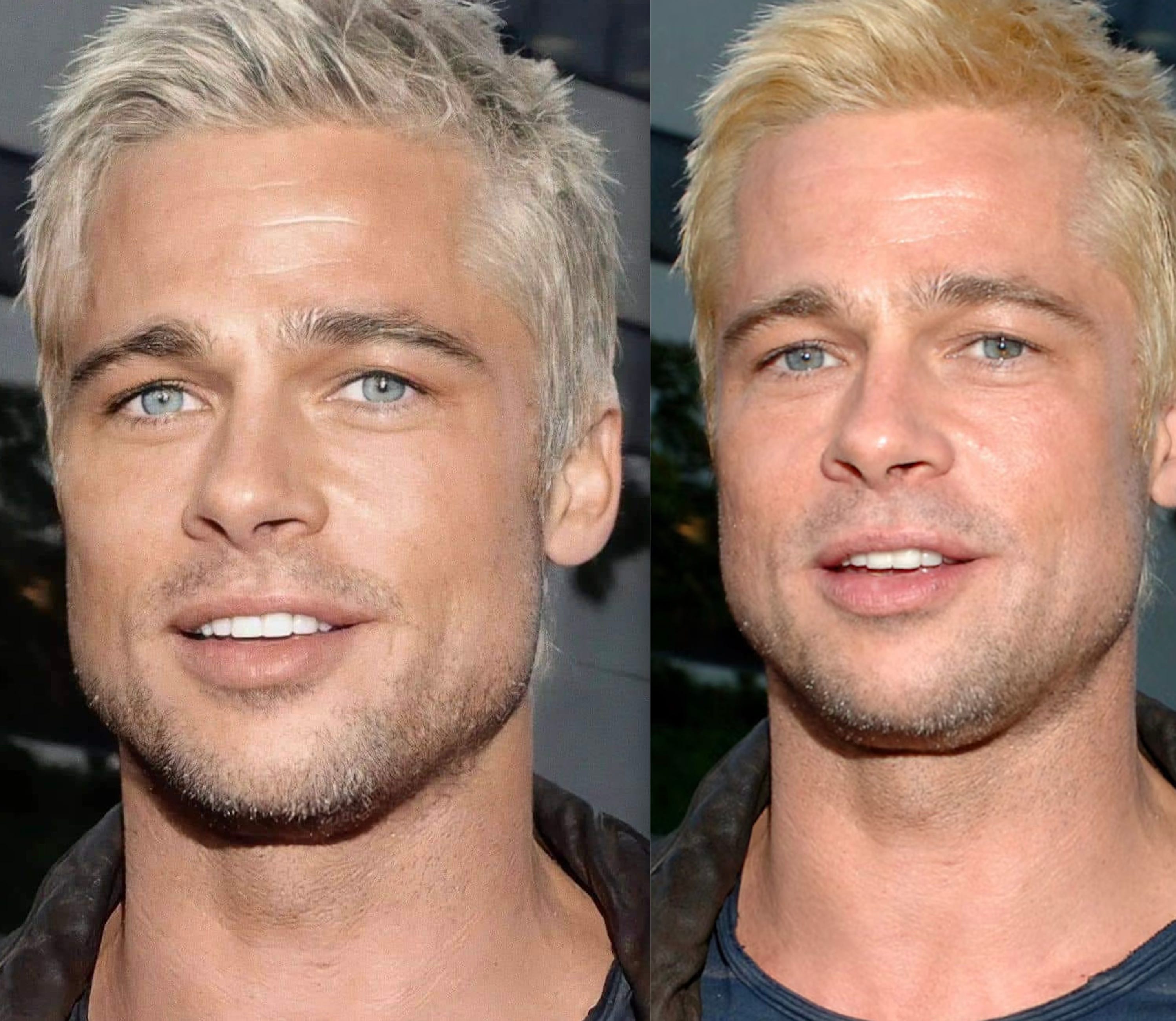
More often than not, even more so than politics, I find myself fighting over the veracity of images.
Is it a pet peeve of mine, or are we in the midst of a global war on reality? That’s the question.
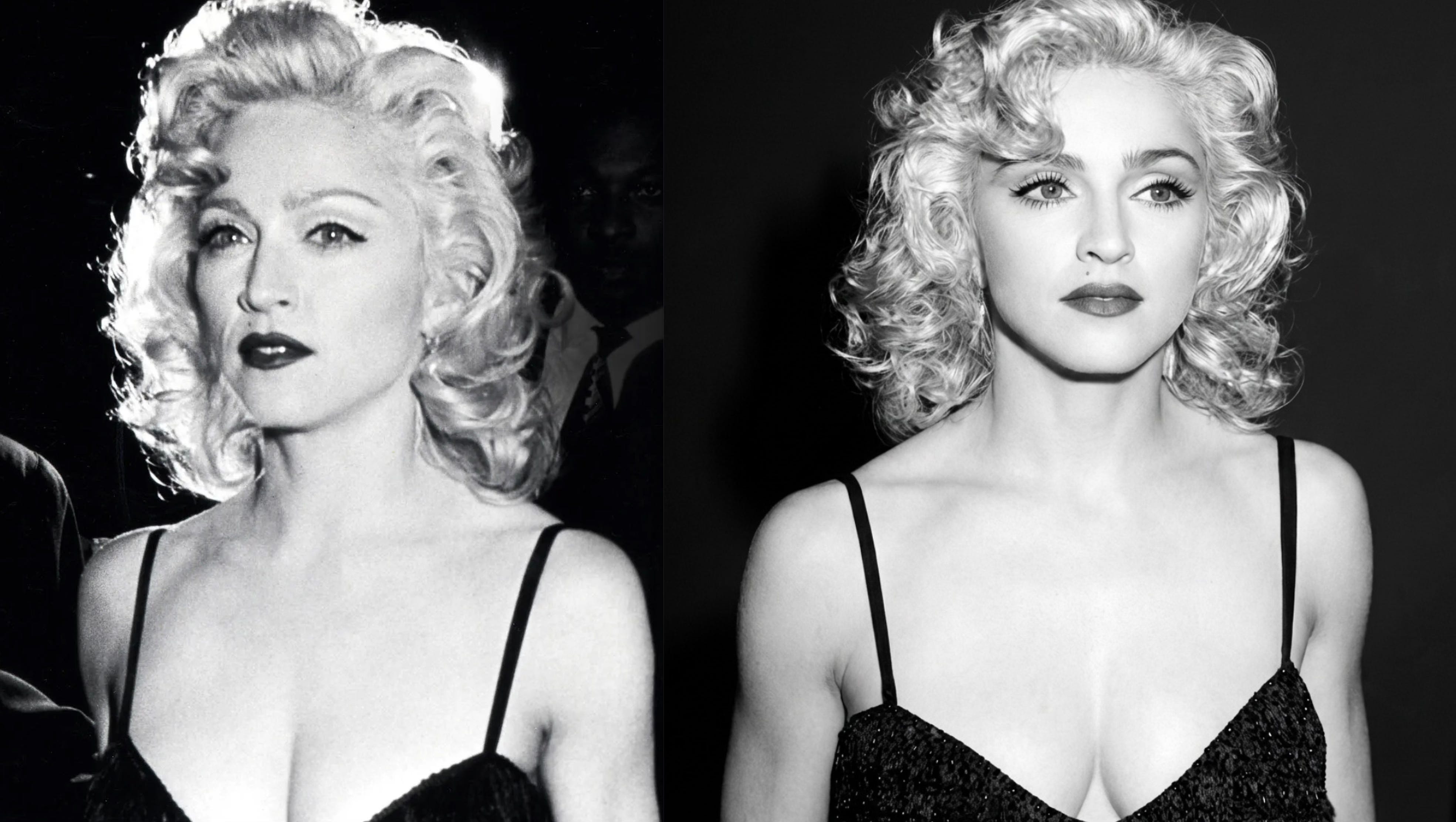
For example, a couple of accounts devoted to Madonna (I’m a longtime fan and biographer) have taken to “restoring” images of her, often images that only exist in grainy form because they were only ever seen in a scanned newspaper, or started life as low-res illicitly leaked outtakes.

Seems harmless enough, but their “restoration” is not Ken Burns-level, just a ham-handed use of AI, which bluntly fills in the blanks. The result is an image that is 4K-sharpened to a fault, and that often uses a later version of her face blended with other cues. Sometimes, they look good. Sometimes, they look bad.

But always, they are not real. Yet always, most people think they are.
People react to these Frankensteins with “oh, she was so pretty there,” “never seen that one,” “didn’t realize she wore that color.” All reacting to a largely made-up image, one that is then promptly shared by dozens of other accounts with no “AI” tag — and it becomes fact.

(Not to mention that recent official images of Madonna are presented to us already very tampered with, so much that it could be argued they should be de-stored. But I digress, and I believe however an image is presented is, if nothing else, the default historical go-to. While it would be interesting to see the unretouched image from an album cover, the album cover is arguably still reality, while a fan-filtered album cover is not.)
I think dismissing this image-manipulation trend as the unavoidable wave of the future is a mistake. In that fanbase and countless others, there is a growing number of self-elected fans who seem to have an urge to overwrite history with their own touch. There is a hint of the forger’s pride in this pursuit, and it maddens me that people, by and large, can’t really see when something has been grotesquely sharpened, over-generously filtered or even wholly created.
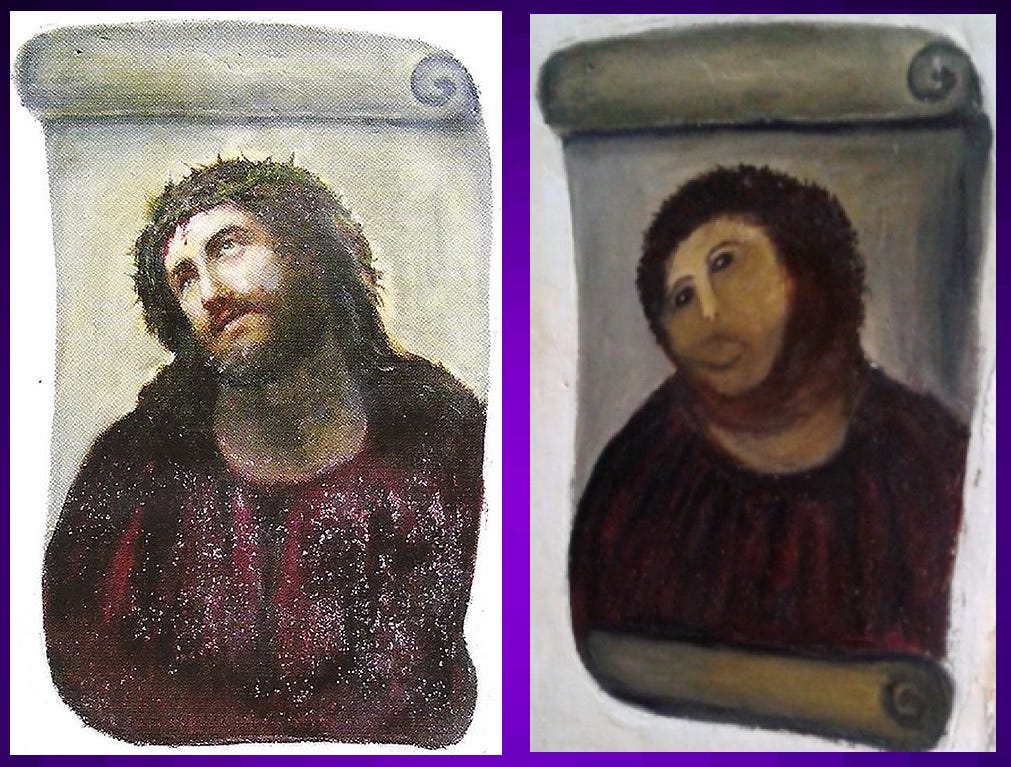
I can’t help being reminded of the Spanish woman who destroyed an old fresco when she took it upon herself to paint over it. With a laughable skill set, she produced a turd — but one that has since become a celebrated tourist attraction. When she died, the lady — who could be called a well-intentioned vandal — was applauded in a New York Times obituary. Somehow, I don’t think her good-faith efforts to improve upon a more important piece of work would have been so celebrated.
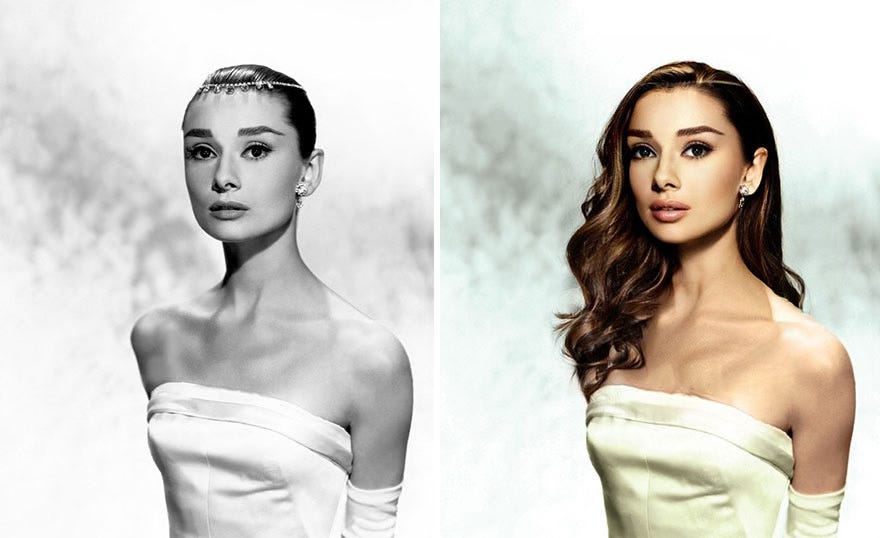
It’s especially bonkers that this trend seems sensationally active across nostalgia groups. In my mind, what could be more absurd — or what should be more instantly identifiable as fakery — than an image of Marilyn Monroe that’s been yassified? Elizabeth Taylor, Rita Hayworth and Audrey Hepburn glamour shots don’t need another layer of filtering.
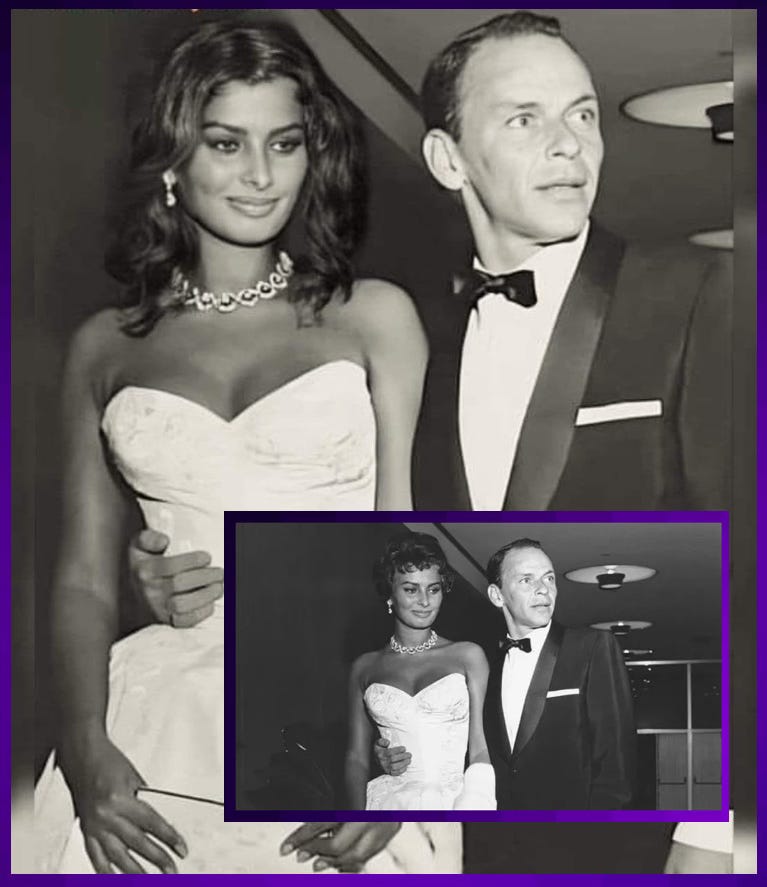
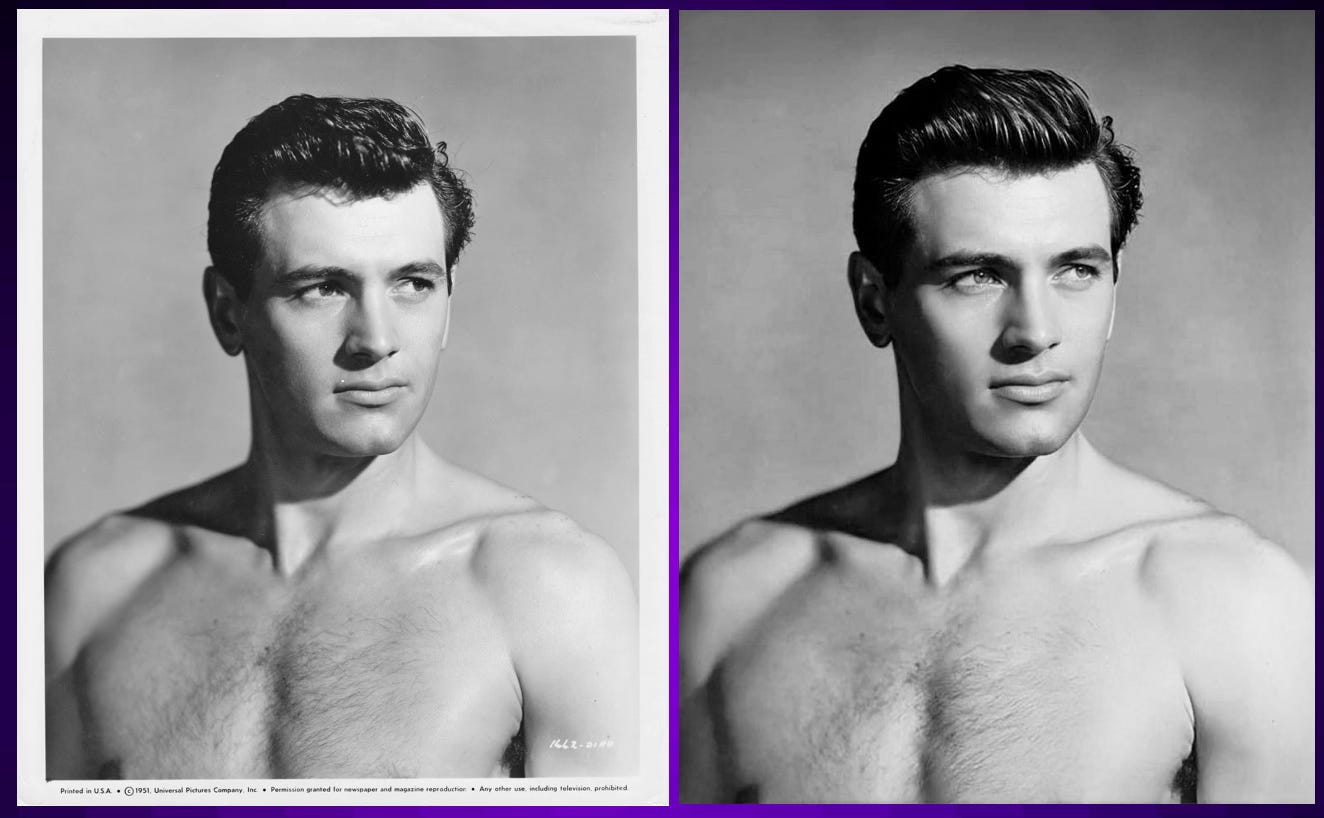
All of this is by way of introduction to my stance that I think we should be aware of when images are originals, even when the originals have been retouched in the traditional sense, and when they are not.
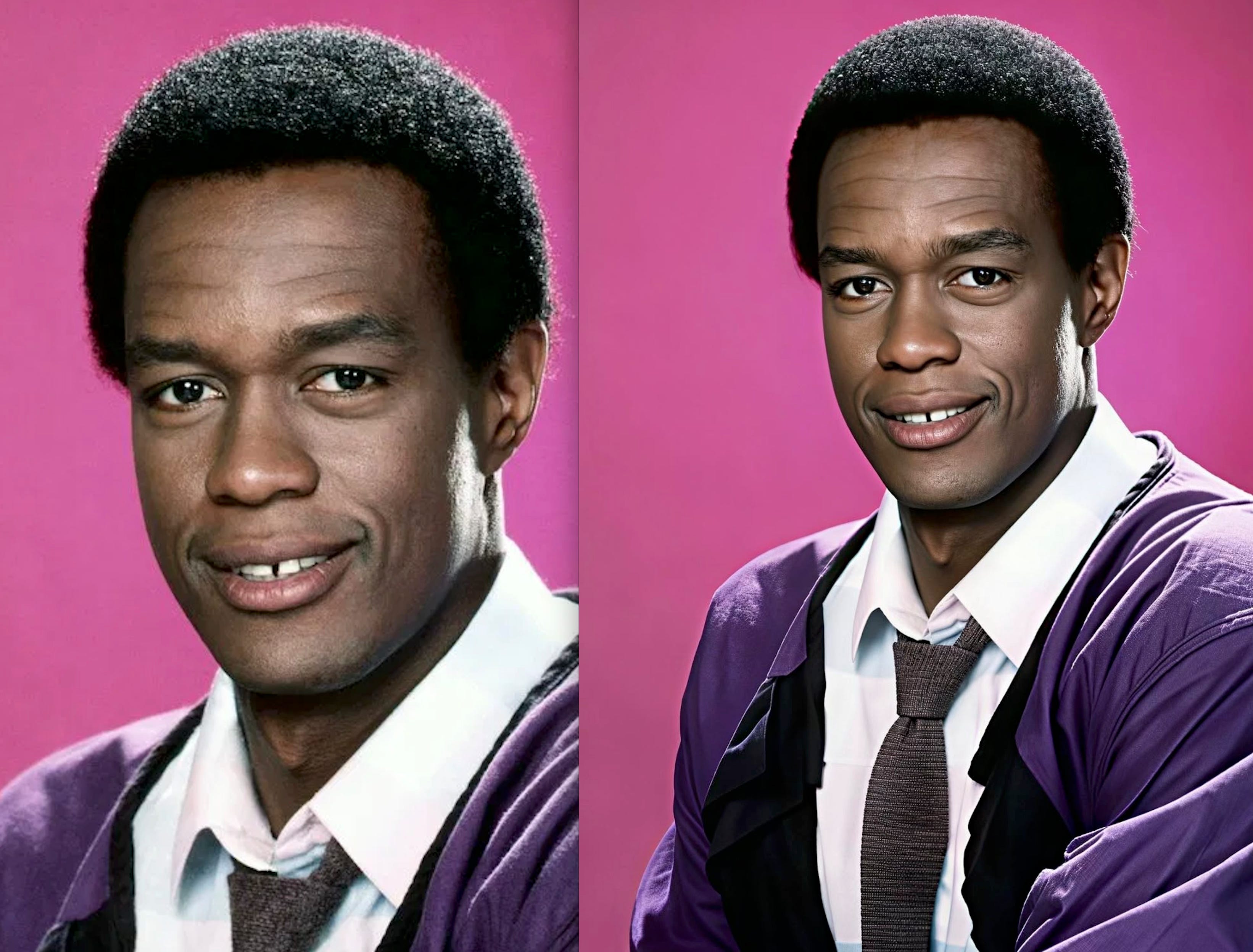
For years, I’ve kept notes on images of public figures that people online routinely fight over, arguing “that’s him!” / “no, it’s not!” or “I would know her anywhere!” / “you’re nuts!”
Many, if not most, of these aren’t even AI. As scary as it is to me how AI-blind people are to begin with, it’s even scarier when they’re totally fooled by sloppy Photoshop intended to deceive or even by mere cases of mistaken identity.
Because it’s a pet peeve of mine — and because I think this is the tip of the iceberg that is a fast-approaching struggle over a shared pop cultural history — for the record, here is a hopefully illuminating and fun key to some disputed images I have seen many times … or expect to see many times in the future.
When we are online, we need to learn to view critically as well as think that way, taking into account: (1) does this image feel right? (2) does this image make sense in context? (3) who is sharing this image and why? (4) does a Google Image search reveal that this image ever existed before recently? and (5) are there telltale signs the image may not be what it purports to be?
And now, for the non-lecture portion of the program, including debunking that naked Tony Danza locker room snap, those early-years Golden Girls pictures and more …
Tom Selleck
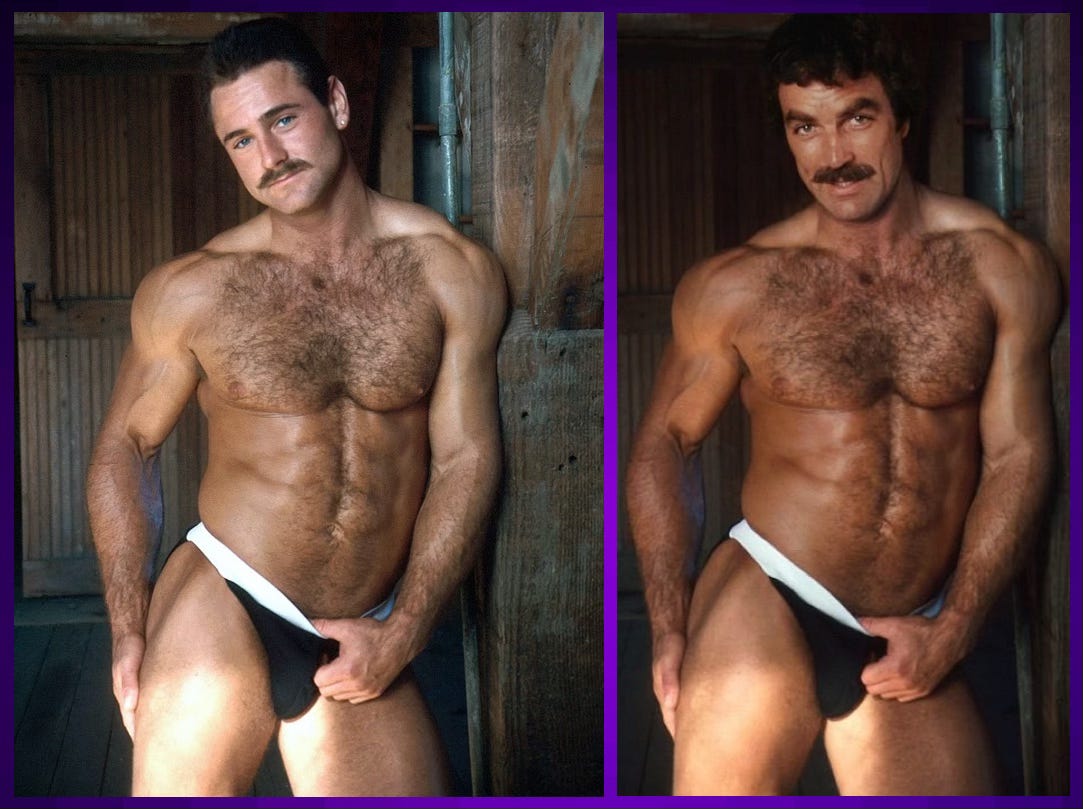
Tom Selleck has such a convincing bodyfake — or maybe people just wanna believe — it’s been sold on eBay as a print and as a poster. Because we can close our eyes and remember the ‘70s and ‘80s as a skin-soaked time when men wore short-shorts and bared their midriffs and more, the idea that Magnum, P.I., would pose provocatively shirtless is easy to accept.
But the image above is actually Tom’s head on the body of a gay porn model by the name of Don Jacobs, who posed for Men Magazine in the late ‘90s in that outfit. Well, “outfit” — a skimpy pair of briefs.

There’s also a more subtly altered Selleck image making the rounds — it shows Tom looking basically perfect, yet with unnecessarily amped-up muscles. Greedy! The Internet is greedy.
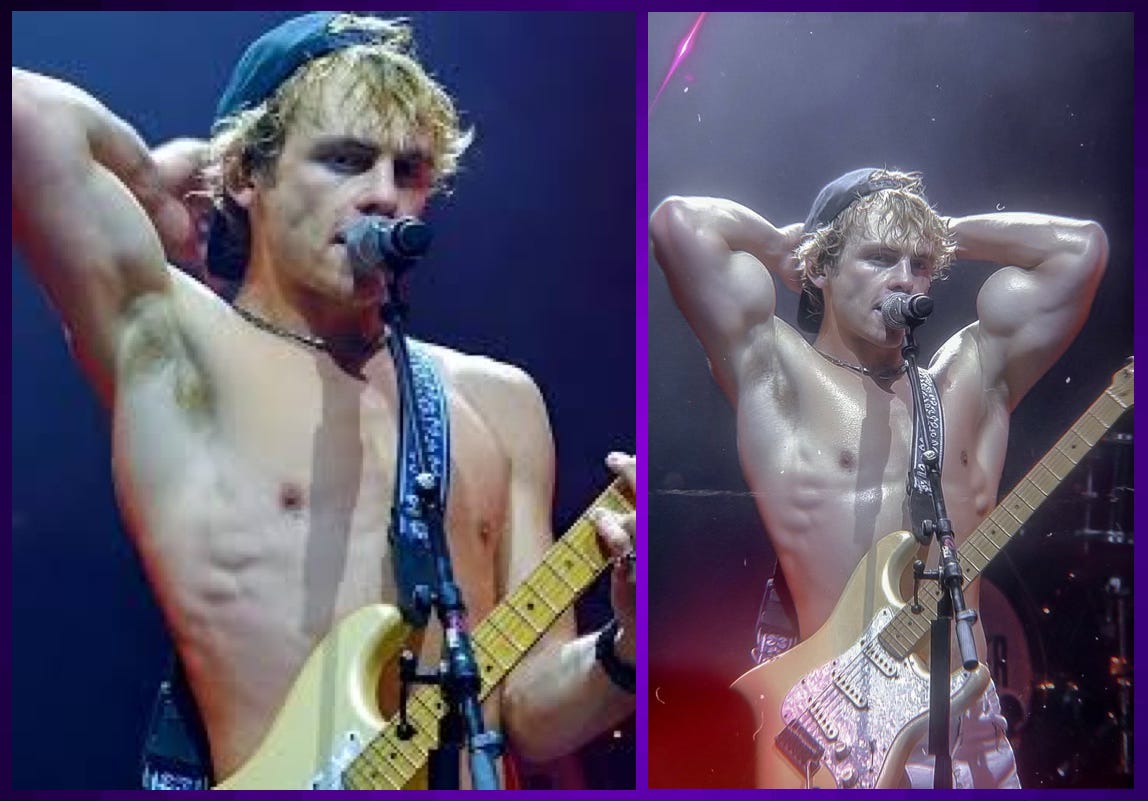
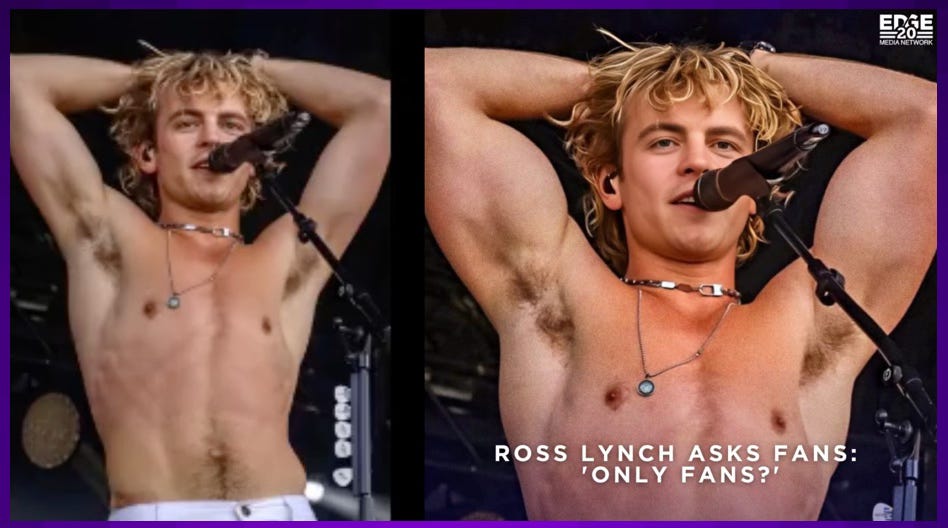
Another recipient of sus biceps is former Disney Channel star turned rocker Ross Lynch. Fans love taking photos of him shirtless in concert, but as fit as he is — and he’s fit — his biceps are nothing like the balloons seen above. If you’re wondering how people become body-dysmorphic, one way could be seeing an altered image of a star that raises the bar right up into the sky … while another could be being that star and seeing a fantastically altered image of yourself.
